

A document that is basically used for transferring ownership of a vessel upon the death of a registered owner is known as a declaration of transmission on death. The registration records of the vessel are updated to show the new legal owner, usually an executor, administrator, or beneficiary. Vessel records may be kept frozen without this declaration, causing ambiguity and delays in estate.
For families and executors, it is easy to overlook vessel ownership during probate. Vessels must officially register changes in ownership unlike personal property. Authorities rely on proper declarations to ensure accurate records, preventing disputes over ownership or responsibility.
The Declaration of Transmission on Death explained in a professional clear manner through this guide. That declaration is important as it outlines how it works and what the documents to be submitted. By appreciating what to expect, both executors and beneficiaries can manage vessel transfers more smoothly and maintain compliance during this sensitive time.
Understanding the Certificate-of-Transmission after Death
The Declaration of Transmission on Death is a form that informs the registration of a vessel that the vessel ownership has changed by virtue of death. An involuntary act does not result in a transfer of property through the means of a sale. It shows a legal transfer of ownership under estate law instead.
This declaration guarantees continuity of files. Registries must be aware of the legal authority holder of the vessel post mortem of the owner. Without this update, it is unclear who is responsible for compliance, insurance, or operation.
This declaration is important as it brings clarity and accountability. It is essential for regulators to ensure accurate ownership records for enforcement and communication. Having formal recognition of one’s authority is beneficial to Executors.
Beneficiaries who complete the declaration protect the future transactions. It establishes a clear chain of ownership, which is necessary for eventual sale or re-registration.
| Record Status | Before Declaration | After Declaration |
|---|---|---|
| Ownership Clarity | Uncertain – Potential for unrecorded liens or contested titles. | Established – A clear, legally recognized chain of ownership is finalized. |
| Registry Accuracy | Outdated – Information may reflect previous owners or obsolete data. | Updated – The registry is synchronized with the current physical and legal reality. |
| Transaction Readiness | Limited – Lenders and buyers are hesitant due to high “due diligence” risk. | Improved – The asset becomes “liquid” and ready for sale or financing immediately. |
| Compliance Confidence | Reduced – Risk of fines or boarding delays due to non-compliant records. | Restored – Operators can move through jurisdictions with full legal standing. |
Documentations Required and Legal Basis
Writing a Declaration of Transmission on Death, meaning signature and publication on a will the registration of the Estate. Authorities are verifying vessels instead of reassessing their eligibility.
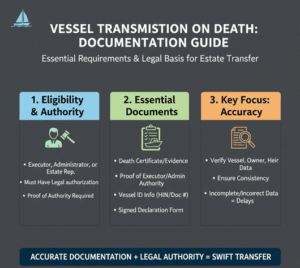
Who is eligible to file the declaration?
The executor, administrator, or appointed estate representative usually files the declaration. Only someone legally authorized can act in the name of the estate. You need proof of authority.
There are multiple beneficiaries, you have to be clear the declaration indicates who holds ownership rights on a temporary or permanent basis owing to estate instructions.
Essential documents for approval
The authorities need supporting documents for the transmission. The documents that confirm the death along with authority and vessel identity, Accuracy is essential.
Documentation elements include common
- Evidence which confirms someone has died.
- Evidence indicating executor or administrator’s authority.
- Information on vessel Id.
- The responsible party completed and signed the declaration form.
Completeness and consistency speed approval and reduce follow-ups.
Results With and Without Proper Transmission
A comparison with related processes clearly demonstrates the practical significance of a Declaration of Transmission upon Death. With correct transmission, registry records update quickly.
Records would become obsolete without transmission. Transactions or communication may be denied. This causes delays and adds a burden to the paperwork.
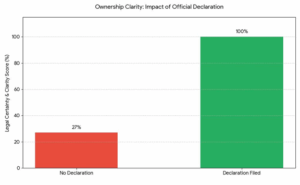
- Definitive Legal Shift: Official Launch Effect: Getting the declaration filed, the legal certainty (27% to 100%) of the vessel jumps from a presumed owner of the vessel state to an actual registered vessel national state.
- Completion of Transmission: The stage Transmission Completed indicates that the registry has reviewed all support documents and the gap between a private sale and public sale has been closed.
- Unlocked Financial Value: A vessel’s No Declaration status frequently prevents lenders from issuing Preferred Ship Mortgages. Lenders require 100% certainty, which is only provided upon the filing of the No Declaration and associated documentation.
- Operational Protection: An operational protection is achieved as a filed declaration shields any international visits that may occur. It provides the necessary confidence in compliance to prove nationality and ownership to foreign authorities without delay.
The chart illustrates an improvement in clarity after filing the declaration. Despite its simplification, it reflects typical administrative results.
Real-life instance
The executor postpones the declaration. A request for proof of ownership by a buyer. A different executor quickly submits the filing and completes the sale seamlessly.
This comparison demonstrates that taking action early on prevents complications.
Actions Executors and Beneficiaries Can Take
Preparing and organizing managing vessel transmission. Executors should identify vessel assets early in the administration of the estate. Understanding stops mistakes.
Prepare documents before filing. Aligning names and vessel codes saves processing time. Speed is no substitute for accuracy.
Promptly submit the Declaration of Transmission on Death. Delays can hinder compliance, insurance or sale opportunities. Submitting early protects the interests of the estate.
Keep confirmation of registry updates. These documents provide assurances for the future. Paperwork is handy later on.
Some best practices are helpful
- Recognize vessel assets at an early stage
- Confirm documentation of executor authority
- Submit the declaration as soon as possible
- Retain copies of registry confirmations
Following these steps makes estate administration easy
The significance of the Declaration of Transmission on Death
An essential subsequent step in the transfer of ownership of the vessel after the owner’s death. It modifies the official record, establishes legal authority and protects all parties. Often, uncertainty and delays come about.
Executors and beneficiaries should understand and complete this declaration promptly. National Vessel Registry Center, Corp. reliable records minimize disputes, enhances compliance and serves future transactions. The process is administrative but has a significant impact.
Families will transmit their asset in an organized way and leave the vessel the right way. This provides peace of mind while ensuring a legal transfer of ownership during a challenging time.
FAQ
Frequently Asked Questions About Declaration Of Transmission On Death: Guide for Vessel Owners
How does this article help with declaration of transmission on death guide?
This article adds context around declaration of transmission on death guide, while the linked service and archive pages below help you move from research to action so you can move to the correct next step.
What information should I gather before taking the next step?
It helps to have the relevant vessel details, ownership information, and any current registry or licence numbers ready before you compare forms, filing paths, or related updates.
Where should I continue reading on this topic?
Use the related pages and resources below to review the main service page, the matching archive, and closely related internal topics.
