

Many owners of vessels enter into financing arrangements without understanding how vessel mortgages work. Delays, enforcement issues, and problems at the time of sale or transfer may occur. Registration helps to bring transparency and also protect the interest of both parties. This article provides an explanation of the Mortgage of Vessel in a professional way. Understanding this will help stakeholders in vessel financing with legal confidence and clarity.
A Vessel’s Mortgage Explained
A mortgage on vessel is a registered charge against the vessel made to secure the repayment of a loan. The ship is collateral for the loan. Once obligations are completed, the mortgage is discharged. Otherwise, the lender may exercise their rights under applicable law.
Unlike personal loans, we register vessel mortgages in an official registry. This registration gives public notice of the lender’s interest. It stops secret claims and sets priority of creditors.
Certainty lies at the heart of vessel mortgages. Owners can access financing, and lenders gain assurance that their interest is legally protected. Registry records allow third parties to check if a vessel is encumbered.
Mortgage records are important for buyers and insurers. They disclose established financial claims that could influence transfer or coverage. Transparent maritime transactions rely on precise mortgage registration.
| Aspect | Mortgaged Vessel | Unencumbered Vessel |
|---|---|---|
| Financing access | Available | Limited |
| Registry disclosure | Required | Not applicable |
| Transfer restrictions | Present | Minimal |
| Lender protection | High | None |
Sign Up, Precedence and Legitimate Influence
It is essential to register a mortgage of a vessel for enforceability. Registry records are relied upon by authorities to ensure notice and priority.
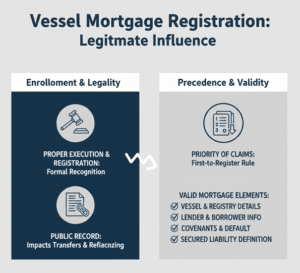
Enrolment procedure and legality
For a mortgage to be valid, the parties must properly execute and register it in the vessel registry. The vessel formally recognizes the mortgage as existing and tied to it. Without registration, the lender loses protection.
When registered, the mortgage becomes part of the vessel’s public record. It changes transfers, refinancing, and enforcement actions. It is important to be precise during capturing quality.
Multiple Mortgages and Priority
If enforcement occurs, priority decides the order in which lenders are paid. Usually, priority follows the registration orders. Mortgages registered first usually have priority.
One ship can have multiple mortgages. Registry order aids in resolving claims equitably.
A valid mortgage would include common elements
- They identify the ship and registry details.
- Easy to understand lender and borrower details.
- Correct Designation and performance
- Secured liability definition.
- Every element aids in legal enforceability.
Comparison of Mortgaged and Non-Mortgaged
- Financing mortgaged vessels is much easier than financing unencumbered vessels.
- Registering a mortgage provides collateral for the lender.
- The absence of security limits the financing options of unencumbered vessels.
- The registration of mortgages allows companies to expand their operations and invest in more upgrades and fleet expansion.
- Opting for this alternative adds legal obligations and disclosure requirements to the mortgage.
Owners and lenders practical guidance
Before registration, owners must understand mortgage term. Confusion breeds conflict later. Lenders should ensure they complete the registration on time. Waiting weakens priority and safeguards. Registry entries need to be verified. Mortgage status check by owners. A formal discharge must be registered upon repayment. Not discharging will block future dealings.
Using helpful best practices
- Evaluate mortgage terms thoroughly.
- Effectively register all mortgages quickly.
- Monitor payback and discharge necessities.
- Keep copies of registry confirmations.
These steps provide for smooth financing relationships.
Mortgage of a Vessel: Importance
A mortgage of vessel of National Vessel Registry Center, Corp. is an important financial and legal instrument that facilitates the acquisition and development of the vessel. It offers access to capital for owners as well as protection for lenders.
Knowing registration, priority and discharge obligations cannot avoid complications. Accurately maintained records help in transfer, refinancing, and compliance. The clarity will ensure the value of the vessel and continuity of operation.
A well-developed understanding of vessel mortgages will enable the owner and lender to create an effective and secure financing structure. Right management of a mortgage provides confidence, compliance and continuity of a ship at sea.
FAQ
Frequently Asked Questions About Mortgage Of Vessel: A Complete Guide for Owners and Lenders
How does this article help with mortgage of vessel guide?
This article adds context around mortgage of vessel guide, while the linked service and archive pages below help you move from research to action so you can move to the correct next step.
What information should I gather before taking the next step?
It helps to have the relevant vessel details, ownership information, and any current registry or licence numbers ready before you compare forms, filing paths, or related updates.
Where should I continue reading on this topic?
Use the related pages and resources below to review the main service page, the matching archive, and closely related internal topics.
