
Boats are great assets, giving their owners all kinds of wonderful opportunities, from the owner’s leisure activities to, possibly, running a business. Still, before cruising, it is very necessary to get acquainted with the legal obligations that concern the boat owners. A considerable part of the whole procedure is finding out the way of register boats in Canada. Registration is the key to meeting the Canadian Navigation Laws, safeguarding proprietorship, and allowing for travel abroad under the Canadian flag.
This is a complete, detailed and stepwise plan about boat registration, its necessity, basic steps, and detailed comparisons with the licensing, alongside some practical and easy-going tips. If you are a new owner or just thinking of changing your boat, the knowledge of how to properly register boats will keep you safe and will free your mind.
The Basics of Registering Boats in Canada
When boats are registered in Canada, they are linked to the Canadian Register of Vessels. In fact, for a large number of vessels, such as those that are used for commercial purposes or international navigation, this is not an option, the registration is mandatory. Apart from that, registration allows identification as per Canadian law and confers ownership rights akin to those acquired through property registration.
Why Registration Matters
- It establishes legal proof of ownership.
- It allows boats to travel internationally under Canada’s flag.
- It permits financial institutions to secure mortgages against vessels.
- It provides a unique official number and name for each boat.
| Feature | Register Boats in Canada | Pleasure Craft License (PCL) |
|---|---|---|
| Proof of Ownership | Yes | No |
| International Travel Rights | Yes | No |
| Financing and Mortgages Allowed | Allowed | Not Allowed |
| Unique Vessel Name Required | Yes | No |
Boat registration is the basic step necessary for the security of the owner’s rights over a long period of time as well as for wider usage possibilities, especially for commercial and large boats.
How to Register Canadian Boats
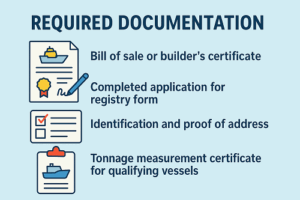
Knowing how to register boats in Canada is a process that involves being well prepared and meticulous with the paperwork. Incomplete documents or applications usually cause a delay in the approvals.
Required Documentation
- Bill of sale or builder’s certificate.
- Completed application for registry form.
- Identification and proof of address.
- Tonnage measurement certificate for qualifying vessels.
To National Vessel Registry Center, you must first collect all the necessary ownership and vessel documents. Once gathered, complete and submit the registry application along with the required information. After submission, pay the government fees applicable to your vessel type. Finally, await approval from the authorities and the issuance of the Certificate of Registry.
Renewal Obligations
Boat registration is a time-limited process and must be renewed from time to time. The owners have the obligation of updating the documents and making the payments on time. Delays in renewals can lead to a fine or the certificate may be invalidated.
Expenses of Registration
The amount of money depends on the boat’s dimensions and type of vessel. A commercial vessel is usually charged a higher fee than a small recreational boat. The accuracy of the data is what leads to avoiding surprise fees.
Owners who understand each stage of the process can comfortably carry out the registration and be sure of complying with Canadian regulations.
Registration or Licensing: Which One Is Necessary?
Deciding whether to register a boat or get a license is a question of its function and size. Registration gives you more security and rights whereas licensing is usually for recreational purposes only.
- Ownership Proof: Only registration offers full legal proof.
- Travel Options: Registered boats can travel internationally, licensed boats cannot.
- Financial Use: Registered boats can be used for mortgages, licenses cannot.
Such a comparison reveals the reasons why a lot of owners favor registration among which are those with bigger assets or global plans.
Ways to Register Vessels in Canada that are Useful
Knowing the steps is virtually just the first step of the whole process. Below are some practical tips that will help you get a hassle-free registration:
- Prepare in Advance – Collect documents before starting the application.
- Confirm Eligibility – Check whether your vessel requires registration or licensing.
- Consider Professional Help – Agencies can simplify paperwork and avoid errors.
- Track Renewal Dates – Mark expiry dates to avoid penalties or suspension.
The mentioned steps are the best way to go for the owners to dodge the waiting time and guarantee that their boats will be functional both in Canadian waters and abroad.
Become the Owner of Your Boat Right Now
While the act of registering a boat in Canada is merely a legal obligation, it still serves as a protection against the ownership, the financing, and the free passage in the international waters. Registration is the identification of your vessel as part of the fleet officially registered in Canada, hence the safety assurance to you as the user, be it for commercial or recreational purposes.
It is advisable not to postpone the process. Come up with a fully compliant, safe, and a boat ready to hit the horizon at any time. Receive your registration today and have the right to exercise the full advantages of the ownership that is recognized by the Canadian law.
FAQ
Frequently Asked Questions About How to Register Boats in Canada: A Complete Guide
How does this article help with register boats in canada complete guide?
This article adds context around register boats in canada complete guide, while the linked service and archive pages below help you move from research to action so you can move to the correct next step.
What information should I gather before taking the next step?
It helps to have the relevant vessel details, ownership information, and any current registry or licence numbers ready before you compare forms, filing paths, or related updates.
Where should I continue reading on this topic?
Use the related pages and resources below to review the main service page, the matching archive, and closely related internal topics.
