
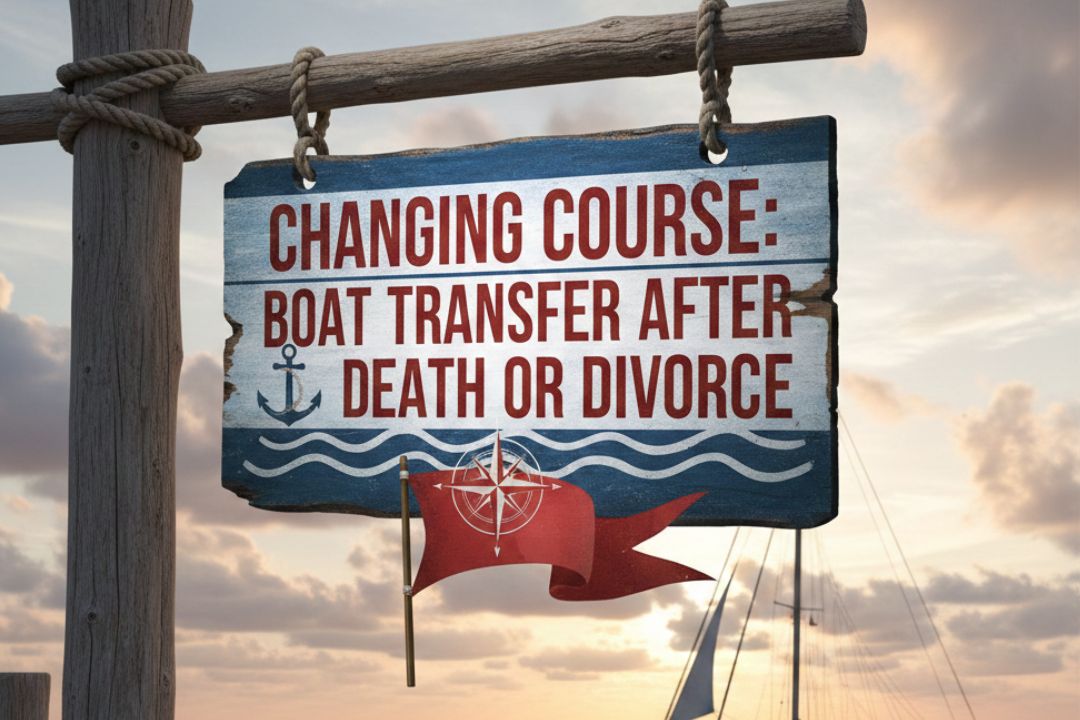
When life shifts unexpectedly, boat ownership can change just as quickly. Whether you are managing an estate or separating assets after a marriage ends, a boat transfer must be handled promptly and correctly to stay compliant with Canadian maritime requirements.
At National Vessel Registry Center Corp., our service simplifies the online filing process for Transport Canada boat registration and pleasure craft licencing so you can move forward with clarity and confidence.
Major life events often create legal and administrative responsibilities that cannot wait. We understand how challenging this time can be. As such, we do everything in our power to make the process easier.
Transferring a Boat After a Death
The passing of a boat owner does not automatically move ownership to a spouse, child, or beneficiary. Instead, the boat becomes part of the deceased’s estate. That distinction affects how the transfer is processed under federal rules.
Transmission vs. Transfer
When someone dies, the boat is not “sold” in the ordinary sense. It is transmitted to the estate. Keep in mind:
- The legal term used is “transmission,” not sale
- Ownership passes through the estate before any beneficiary receives it
- The estate representative must act before a new owner is recorded
This difference is more than semantic. A traditional sale assumes a living seller who signs a Bill of Sale. After death, that is no longer possible. The estate process fills that gap.
If the estate intends to keep the boat, sell it, or distribute it to a beneficiary, the transmission must be formally recorded before any further transaction takes place.
The Role of the Executor
Under current Transport Canada requirements, only the Executor (or court-appointed estate representative) is authorized to sign on behalf of the deceased owner.
The Executor must typically provide:
- A stamped copy of the Will, if applicable
- A Death Certificate
- Confirmation of their legal authority to act
No other family member may sign unless formally appointed. Even if a spouse co-used the boat for years, legal authority must be established first.
Through our service, we provide the appropriate federal forms required to complete the change of ownership within the Transport Canada system. You submit your completed documentation through our portal, and we streamline the filing process for you.
Form 8: Declaration of Transmission
Unlike a Bill of Sale, which reflects a voluntary transaction between living parties, Form 8 – Declaration of Transmission is a sworn statement.
This declaration confirms:
- The Executor has lawful authority over the estate asset
- The boat identified by its Hull Identification Number (HIN) or licence number is part of the estate
- The transfer to the beneficiary or purchaser is legally permitted
Because it is sworn under oath, accuracy is critical. Incorrect or incomplete filings can delay approval.
Once recorded, the estate can proceed with the next stage of ownership—whether that means keeping the boat within the family or initiating another boat transfer to a third-party buyer.
Divorce and Separation: Changing Ownership Properly
Marital breakdown often involves dividing property, and boats are no exception. When a couple separates, the change in ownership must be reflected in federal records.
Separation Agreements as Proof
Transport Canada now explicitly recognizes Separation Agreements and Divorce Agreements as valid proof of ownership for transfer purposes.
If the agreement clearly states that one spouse receives the boat, and identifies it by HIN or licence number, it can serve as the basis for updating records.
Relevant documentation may include:
- A signed Separation Agreement
- A Divorce Agreement
- Supporting identification details for the boat
Our portal enables you to file the appropriate change so the federal record reflects the new sole owner.
Court Orders in Contested Cases
If the divorce was contested and resolved by court judgment, a formal Court Order can also support a transfer.
To be accepted, the order should:
- Clearly identify the specific boat
- Include the HIN or pleasure craft licence number
- Award ownership to one named party
Where a judge assigns ownership, that order replaces a traditional sale document. The filing must still be completed promptly so the government registry reflects the correct owner.
The Joint Ownership Trap
Many married couples hold boats as Joint Tenants. In this structure:
- Both individuals share equal ownership
- If one spouse is removed due to divorce, records must be updated
- A formal amendment is required within 30 days
Even if one name is simply being deleted, it is not automatic. A formal update to the Pleasure Craft Licensing system must be filed, and a statutory fee applies.
Failing to complete this boat transfer within the required timeframe can create complications if the remaining owner attempts to operate or sell the boat.
The “No Title” Myth in Canada
Heirs and newly single owners often begin by searching for a “boat title,” expecting something similar to a car ownership slip. In Canada, that document does not exist for pleasure craft in the same way.
Pleasure Craft Licence Is Not a Title
A pleasure craft licence serves as an identification document. It displays the licence number that must be marked on the boat.
It does not:
- Prove ownership in the same way as a provincial motor vehicle title
- Replace underlying legal documents such as agreements or court orders
- Automatically update when ownership changes
This distinction is essential during a boat transfer. The federal record must be updated through the proper filing process to reflect the new owner.
Be Careful About the Small Vessel Register
Canadian boat registration under the Small Vessel Register is a separate federal system with different legal implications. Pleasure craft licencing and the Small Vessel Register are not equivalent programs, and they serve different regulatory functions.
Lost Paperwork and Declarations Under Oath
If the original paperwork is missing, heirs may still proceed. Current rules require a Declaration Under Oath in certain situations.
This may involve:
- Swearing that the information provided is accurate
- Having the declaration signed before a Notary or Commissioner of Oaths
- Providing a full side-view photo of the boat to confirm its existence
These safeguards help ensure that the federal database reflects a real, identifiable boat.
If you are unsure whether additional verification is required, our online system guides you to the appropriate filing form so your boat transfer can move ahead without unnecessary back-and-forth.
Before proceeding, some buyers also choose to check boat history to confirm there are no outstanding encumbrances or discrepancies. While that is separate from filing, it can provide reassurance before finalizing a transaction.
The 30-Day Filing Window
Timing is critical once probate is granted or a divorce becomes final.
Under current requirements:
- Ownership changes must be reported within 30 days
- Failure to initiate the transfer can render the pleasure craft licence deemed invalid
- Operating the boat during this gap may expose the operator to fines
The potential penalty for operating with invalid licencing can reach $250. Insurance coverage may also be jeopardized if the recorded owner does not match the individual in possession of the boat.
This means:
- Executors should act promptly once authorized
- Divorced spouses should not delay filing
- Buyers acquiring a boat from an estate should confirm the prior transmission has been completed
Our service exists to make this process more manageable. By providing online access to the required federal forms and submission pathways, we reduce delays that often occur with paper-based processes.
Additional Situations That May Intersect with Ownership Changes
Boat transfer transitions sometimes overlap with other regulatory considerations.
For example:
- A boat that will be used in bareboat charters may require separate compliance steps
- A change from personal use to commercial registration status may involve Canadian boat registration rather than pleasure craft licencing
- Estate sales may involve multiple successive transfers if beneficiaries resell the boat
Each scenario requires that federal records accurately reflect the current owner before the next transaction takes place.
Even when the change seems minor—such as removing a former spouse’s name—the update is legally significant.
Canadian Laws Governing Boating Changes
Canadian maritime laws, under the Canada Shipping Act, 2001, govern how boats are documented, transferred, and operated. These rules apply when ownership changes due to death, divorce, or separation. Missing deadlines or misunderstanding procedures can lead to fines, insurance complications, and unnecessary delays.
How Our Online Portal Supports Your Boat Transfer Filing
At National Vessel Registry Center Corp., our service is built around clarity and accessibility.
We provide:
- Online access to the official Transport Canada forms
- Digital submission pathways
- Structured filing guidance within the portal
- Secure processing of your application
We do not secure external documents on your behalf. Instead, we make it easier for you to use the documents you already have to complete your filing properly.
When life events demand administrative action, our platform helps you complete each required boat transfer efficiently, reducing confusion and minimizing the risk of non-compliance.
If you are facing an estate situation, navigating divorce terms, or correcting outdated records, acting within the prescribed timeframe protects both your legal standing and your ability to operate the boat confidently.
A properly recorded transfer ensures:
- The correct owner appears in federal records
- The pleasure craft licence remains valid
- Insurance coverage aligns with actual ownership
- Future sales or registrations proceed smoothly
Life can change direction quickly. When it does, ensuring your paperwork keeps pace allows you to move forward easier.