
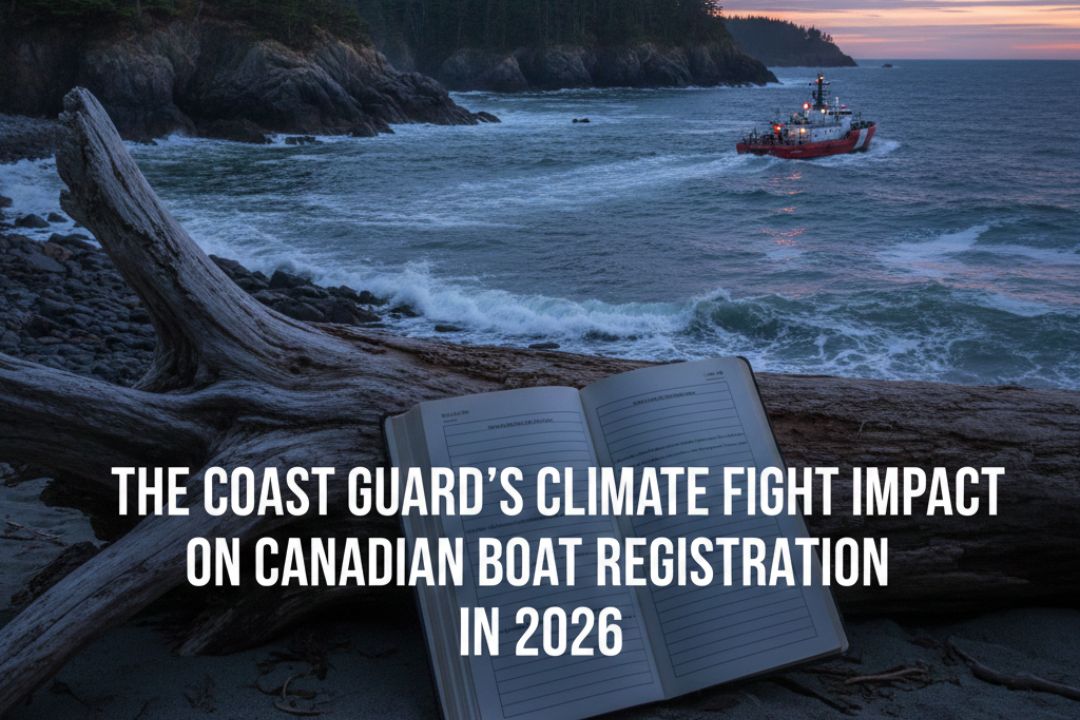
Extreme storms, unpredictable ice movement, and growing environmental response demands have pushed the Canadian Coast Guard. For boat owners across the country, these changes are no longer abstract policy discussions. They directly affect how Canadian boat registration functions, how quickly authorities can respond during emergencies, and how Transport Canada manages records tied to climate resilience.
boat registration
At National Vessel Registry Center Corp., our service exists to make it easier to navigate Transport Canada processes through a centralized online portal. As climate pressures reshape enforcement, response, and monitoring, registration and licencing systems are becoming more interconnected with national priorities.
The Coast Guard’s evolving role is changing expectations for boat owners in 2026, particularly when it comes to accuracy, renewal timelines, and visibility in federal databases.
Climate Pressure on the Coast Guard in 2026
The Canadian Coast Guard has entered 2026 under unprecedented strain. According to reporting from The Globe and Mail, record-breaking storms and rapidly changing ice patterns placed the fleet under intense operational pressure during the early months of the year.
These environmental shifts are not isolated incidents. They represent long-term patterns that affect:
- Search and rescue response times
- Environmental spill containment
- Monitoring of grounded or abandoned boats
- Arctic and northern waterway access
- Coordination with other federal agencies
As climate events accelerate, the Coast Guard increasingly relies on accurate federal databases to act quickly. That reliance places boat registration and licencing data at the center of response operations.
The Coast Guard’s Integration Into National Defence
In September 2025, the Coast Guard was integrated into the Department of National Defence. By 2026, the effects of that change are being felt across maritime oversight.
This integration has led to:
- More rigorous monitoring of Canadian waters
- Expanded security and environmental response mandates
- Increased inter-agency data sharing
- Higher expectations for traceable boat ownership
- Greater scrutiny of unregistered and outdated records
For boat owners, this means federal systems are no longer operating in silos. Registration data, licencing status, and historical ownership records are now used across multiple departments during climate and security events.
Registration as the First Point of Reference During Environmental Response
When environmental emergencies occur, response teams need immediate clarity. During oil spills, fuel leaks, or grounded cargo incidents, the Coast Guard does not start by visually identifying boats on the water. They start with databases.
Canadian boat registration systems are used to:
- Identify nearby boats that may assist during emergencies
- Locate owners tied to hazardous or abandoned boats
- Confirm tonnage, fuel capacity, and structural details
- Determine whether a boat poses an environmental risk
- Support remediation and cleanup planning
When a boat is missing from the system, response efforts slow down. In a climate emergency, delays can mean wider contamination or prolonged navigational hazards.
The 2026 Reality for Unregistered Boats
In 2026, an unregistered boat effectively becomes invisible to federal responders. Without an active record, authorities may not know:
- The size or construction of the boat
- The type and volume of fuel onboard
- The registered owner or operator
- Whether the boat has prior incidents on record
- If the boat qualifies under the small vessel register
From a response standpoint, this creates uncertainty at the exact moment when clarity matters most.
This is where Canadian boat registration intersects directly with climate resilience. Accurate records support faster decisions during high-stakes situations.
Pleasure Craft Licence Changes Now in Effect
As of January 6, 2026, Transport Canada implemented new requirements affecting pleasure craft licence holders. These changes are already reshaping compliance expectations nationwide.
The updated framework includes:
- A $24 fee
- A mandatory five-year renewal cycle
- Updated validation checks during renewal
- Stronger alignment with federal environmental programs
A pleasure craft licence is distinct from registration, and the law treats these systems differently. Boat owners must comply with the appropriate framework based on how their boat is used and classified.
The fees introduced in 2026 directly support the Vessel Remediation Fund. This fund is used by the Coast Guard to remove hazardous boats, including those identified during climate-related incidents referenced in recent environmental reporting.
Climate Funding and Federal Boat Databases
The connection between licencing fees and environmental cleanup is now explicit. Federal authorities are increasingly transparent about how boating compliance supports broader climate response goals.
Funds tied to licencing and registration help support:
- Removal of abandoned boats
- Cleanup of hazardous wrecks
- Monitoring of environmentally sensitive areas
- Long-term planning for climate-driven maritime risks
This reinforces why accurate Canadian boat registration records are no longer viewed as administrative formalities. They are operational tools.
Arctic Access and Climate-Driven Traffic Changes
Climate change is reshaping northern waterways faster than anticipated. The Coast Guard is preparing new polar icebreakers scheduled for deployment in 2026 and 2027 to address expanded Arctic access.
As ice coverage shifts, the Northwest Passage is seeing:
- Increased domestic boat activity
- More foreign traffic through sensitive ecosystems
- Expanded research and support operations
- Heightened sovereignty monitoring
Registration data plays a key role in distinguishing domestic boats from foreign traffic. Canadian boat registration supports tracking, oversight, and environmental protection in these fragile regions.
Federal Law and Registration Compliance
Canadian maritime oversight is grounded in federal law. Boat owners are expected to comply with applicable statutes and regulations governing registration, licencing, and operation.
Relevant requirements are established under Canadian maritime laws:
https://laws-lois.justice.gc.ca/eng/acts/C-24/
These laws clarify:
- When registration is required
- When a pleasure craft licence applies
- How ownership records are maintained
- What information must remain current
- Enforcement authority during environmental events
Understanding where your boat fits within this framework is essential as climate-driven enforcement increases.
How Our Online Portal Supports Boat Owners in 2026
At National Vessel Registry Center Corp., our service is designed to simplify access to Transport Canada forms through one centralized online portal. We do not gather documents or secure approvals. We provide the official forms and make them easier to access, complete, and submit.
Our platform helps boat owners:
- Access Canadian boat registration forms online
- Locate pleasure craft licence applications
- Navigate renewal timelines more efficiently
- Avoid delays caused by outdated paperwork
- Use a streamlined system instead of multiple government pages
As federal systems become more interconnected, having clear access to the correct forms saves time and reduces errors.
Supporting Accurate Records During Climate Events
Climate-driven emergencies rely on reliable data. While we do not participate in enforcement or response, our service supports compliance by making official Transport Canada forms more accessible.
Accurate records support:
- Faster identification during emergencies
- Reduced confusion during inspections
- Clear ownership tracking
- Alignment with federal databases
- Improved environmental response coordination
Canadian boat registration accuracy is becoming an operational necessity rather than a background requirement.
Boat History and Environmental Accountability
Federal agencies increasingly rely on historical data when responding to climate incidents. Ownership changes, prior incidents, and registration gaps all factor into environmental accountability.
Boat owners may need to:
- Check boat history during transfers
- Confirm records before renewal
- Update information after ownership changes
- Ensure historical data aligns with current use
Accurate history supports responsible boating and protects owners during investigations tied to environmental events.
Differentiating Registers and Licencing Systems
It is essential not to confuse federal systems. The small vessel register and pleasure craft licence serve different legal and operational roles. They are not interchangeable, and compliance depends on how a boat is classified and used.
Federal authorities rely on these distinctions when:
- Responding to climate emergencies
- Assessing environmental risk
- Coordinating inter-agency operations
- Tracking Arctic and coastal traffic
Our service helps users access the appropriate Transport Canada forms without navigating multiple platforms.
2026 and the Future of Canadian Boat Registration
As climate conditions continue to test maritime infrastructure, registration and licencing systems will remain foundational to Canada’s response. Canadian boat registration is now closely tied to environmental preparedness, Arctic sovereignty, and emergency response coordination.
Boat owners who maintain accurate, up-to-date records are better positioned to navigate inspections, renewals, and unexpected events. Our online portal exists to make that process clearer and more efficient by providing direct access to the official forms that support compliance in a changing climate.
In 2026, registration is no longer just paperwork. It is part of how Canada responds to a rapidly evolving maritime environment.
FAQ
Frequently Asked Questions About The Coast Guard’s Climate Fight Impact On Canadian Boat Registration in 2026
How does this article help with The Coast Guard’s Climate Fight Impact On Canadian Boat Registration in 2026?
This article adds context around The Coast Guard’s Climate Fight Impact On Canadian Boat Registration in 2026, while the linked service and archive pages below help you move from research to action so the registration path, official number, and any related filing requirements are handled correctly.
What information should I gather before taking the next step?
It helps to have vessel particulars, owner details, tonnage information, and supporting ownership documents ready before you compare forms, filing paths, or related updates.
Where should I continue reading on this topic?
Use the related pages and resources below to review the main service page, the matching archive, and closely related internal topics.