
Small Vessel Register is a register whose objective is to provide ownership and essential details of small vessels which operate in the national waters. For many owners – particularly novices – this register is their first formal move to a legal position. Though generally considered less complex than full vessel registration, it does impose certain legal and compliance obligations.
Registering a small vessel allows authorities to identify ownership, enhance safety oversight, and keep accurate records. It also offers protection to owners as proof of ownership and legal operation. Owners could face difficulties with inspections, insurance claims, or transfers without registration.
This guide is a clear and professional explanation of the Small Vessel Register. It explains what the register is, how it works, the importance of the register to you, the everyday boat owner. If you’re a proud owner of a recreational craft or a small commercial vessel, understanding this register will help you stay compliant and will offer you peace of mind.
Get to know Small Vessel Regs
The Small Vessel Register is a system designed for the registration of vessels that fall below certain size or tonnage limits. This captures critical data like ownership information and basic vessel identification. This system is meant to be easy to use and record reliable data.
The focus of the Small Vessel Register is to ensure efficiency and practicality which is unlike full ship registries. Owners can register their smaller vessels without the complexities related to larger or commercial ships. The register continues to have an important legal function despite its simplicity.
Small Vessel Register is accountable for every event involving the ship. Officials utilize it to validate ownership and create responses to safety or enforcement situations. Proper documentation aids emergency management and regulatory compliance.
Owners get formal recognition by registering. It serves as evidence of ownership which can be used during sales, insurance or dispute. It provides vigorous protection to registration which is not mere formality.
| Aspect | Registered Vessel | Unregistered Vessel |
|---|---|---|
| Ownership proof | Clear | Uncertain |
| Compliance confidence | High | Reduced |
| Transfer readiness | Smooth | Delayed |
| Authority recognition | Established | Limited |
Criteria for Enrollment
Dependent upon the characteristics and use of the vessel, registration is possible. Smaller recreational vessels qualify, while larger or specialized vessels may require a different registration system.
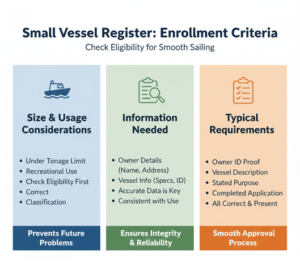
Size and usage considerations of vessels
Size limits determine eligibility. Generally, vessels under certain tonnage limits qualify. It is also important to look at intended use as some commercial activities require additional documentation.
The owner must check eligibility first. Registering under the proper system prevents problems down the line. Correct classification aids compliance.
Information needed for registration
Ownership details and vessel information necessary for registration. Information for names, address, and identifiers need to be correct. Mistakes can slow down approval.
Authorities examine applications to ensure consistency of decision and the usage. Accurate data helps the integrity and reliability of the Small Vessel Register.
Typical needs for registration
- Owner identification information.
- Description and specifications of vessels.
- Stated purpose description.
- Registration application completed.
- All there and all correct.
Comparison of Small Vessel Register with Other Registries
Being aware of the differences between the Small Vessel Register and other registry systems will help owners make the right choice. More detailed documentation is common for larger ships and vessels. Streamlining processes helps small boats.
The registration creates enough recognition for most recreational and limited-use vessels. Alternative registries may be considered by owners for funding or recognition.
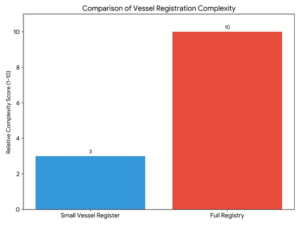
- The Full Registry is over three times as complex as the Small Vessel Register due to the substantial amount of documentation and legislation required to register for commercial registration.
- The complexity score of the Small Vessel Register is low (3/10), making it a simple and compliant option for boat owners needing it only for recreational purposes.
- A more complex Full Registry (10/10) is a fundamental requirement for a larger operator as it provides the legal framework needed to comply with stringent international financing and mortgage requirements; commercial and financial necessity.
Practically Register and Maintain For Those Records
Preparing well will ensure registration success. Owners should collect the right information before applying. Uniformity in records stops delays.
Take a good look at the vessel particulars. You should measure and describe reality. Data helps smooth approvals.
Record-keeping after registration Changes in ownership or address must be informed on time. Up-to-date records safeguard adherence.
Secure proof of registration. Though simplistic, it remains an important document. Records help further transactions.
Beneficial and useful tips
- Check your eligibility.
- Verify that all details submitted.
- Revise files after alterations
- Save your registration confirmations
The latter will give you assurance and compliance for a long time.
In conclusion, the importance of Small Vessel Register
Owners of small vessels can use the Small Vessel Register to obtain legal recognition of their vessel in a simple manner. It helps with clear ownership, compliance with regulations, and assurance in operations. It has legal value, while more simplified than other registries.
Owners with a good understanding of the register experience fewer administrative issues. Accurate registration supports inspections, transfers and insurance matters. National Vessel Registry Center, Corp With this initiative, the vessel is protected as well as the owner.
Vessel owners can operate their vessels lawfully and with peace of mind by registering quickly and maintaining accurate records. The Small Vessel Register continues to be a practical cornerstone of vessel ownership.
