
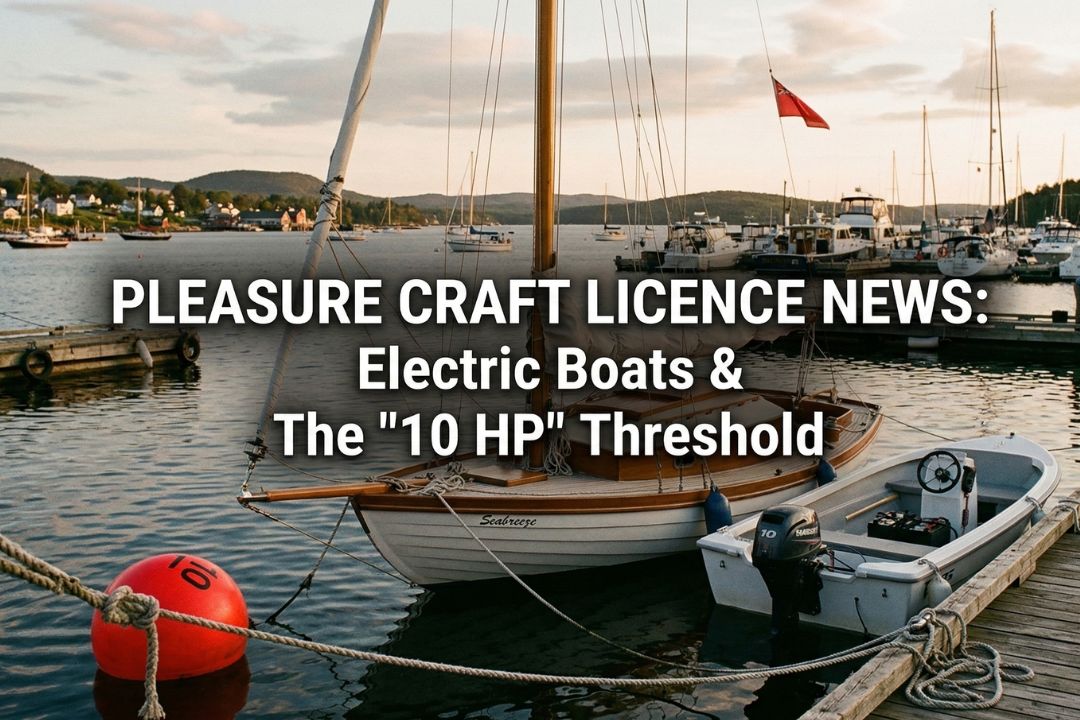
Electric propulsion is rapidly changing recreational boating across Canada. However, the legal framework governing motorized boats has not changed as quickly as the technology. Many boaters still rely on an outdated assumption: that the requirement for a pleasure craft licence begins only when a motor exceeds 10 horsepower.
Electric motors are often listed in kilowatts rather than horsepower, which means many boaters accidentally cross the regulatory limit without realizing it.
The “10 HP” Myth and the 7.5 kW Reality
For decades, the boating community has referred to the “10 horsepower rule.” The idea is simple: if a motor exceeds 10 horsepower, the boat must display a licence number on the bow.
That shorthand explanation remains common in marinas, forums, and boating clubs, but it leaves out a critical detail.
Canadian regulations measure propulsion power at 7.5 kilowatts. Canadian maritime laws actually define the threshold differently. Under the law, the key figure is 7.5 kilowatts of propulsion power. That distinction has become especially important as electric propulsion becomes more common.
Since 7.5 kW equals roughly 10 horsepower, the numbers appear similar. However, the distinction becomes significant when dealing with electric motors that are rated directly in kilowatts.
Here is how the threshold works in practice:
- Boats powered by motors rated above 7.5 kW require a pleasure craft licence displayed on the bow.
- Electric propulsion units typically list power in kilowatts rather than horsepower.
- Even if the horsepower equivalent seems close to 10 HP, the kilowatt rating determines compliance.
- Electric setups often make it easier to exceed the threshold without obvious warning.
Because electric propulsion is frequently modular, boaters sometimes install motors based on thrust or battery efficiency rather than power output. The result can be a boat that quietly crosses the licencing threshold.
Our portal provides access to the forms required to apply for licencing so boat owners can respond quickly when they discover their propulsion system exceeds the regulatory limit.
Electric Propulsion and Aggregate Power
The rules governing small boats also evaluate propulsion power in aggregate.
This means regulators look at the total output of all motors attached to the boat’s transom rather than evaluating each motor individually.
That detail becomes particularly relevant for electric setups, which often use multiple smaller motors instead of a single large engine.
Consider a scenario involving two electric outboards:
- Motor one: 4 kW
- Motor two: 4 kW
- Total propulsion power: 8 kW
Even though neither motor individually exceeds the threshold, the combined output does.
In that case, the boat requires a pleasure craft licence because the total propulsion power exceeds 7.5 kW.
The aggregate rule applies regardless of propulsion type. Gasoline engines, hybrid systems, and electric motors are all counted toward the same limit.
Because electric boating setups can evolve over time, owners sometimes add a second motor after the boat has already been used for a season. When that happens, the boat may cross the regulatory threshold without the owner realizing it.
Our online portal provides a streamlined way for owners to submit the necessary forms once their propulsion configuration changes.
Electric Boat Models That Approach or Exceed the Limit
Electric boating manufacturers have introduced increasingly powerful systems designed for fishing boats, sailboats, and recreational cruisers.
Because their motors are rated in kilowatts, they offer a clear illustration of how electric propulsion interacts with the 7.5 kW threshold.
Boat owners who install higher-power electric systems must ensure their boat displays the appropriate identification number.
In situations where ownership changes, our portal provides the forms needed for a pleasure craft licence transfer so the new owner can ensure the boat’s identification information remains accurate.
2026 Fee and Expiry Changes
Another major update affecting boat owners arrived in 2026. For many years, licencing was widely viewed as a one-time process with no recurring costs. That approach has now shifted.
Beginning in January 2026, new policies introduced both service fees and expiration periods.
These updates include:
- A $24 service fee now applies to each application.
- The fee applies to new licences, transfers, and renewals.
- The amount is adjusted periodically to reflect inflation.
- Licences are no longer permanent.
Instead of lasting indefinitely, each licence now operates on a five-year validity cycle.
When the expiry date arrives, the owner must complete a pleasure craft licence renewal to maintain compliance.
These changes mean boat owners who previously assumed their paperwork would never expire now need to keep track of renewal dates. The transition is particularly relevant for owners installing new electric propulsion systems on older boats that may have been licensed decades ago.
Our service allows boat owners to access renewal forms quickly through a centralized online portal rather than navigating multiple government pages.
The March 31, 2026 Legacy Deadline
Another important development affects licences issued many decades ago.
Some older licences date back to the early years of Canada’s recreational boating programs. Those historical licences often remained valid for generations because they were originally issued without expiration dates.
The 2026 regulatory update established a final deadline for those legacy records.
Important points include:
- Licences issued in 1974 or earlier expire on March 31, 2026.
- Owners must renew them to remain compliant.
- The renewal requirement applies regardless of propulsion type.
This rule has a special impact on owners upgrading older boats with modern electric propulsion. A classic fishing boat from the 1960s, for example, may still carry a historic licence number. If the owner installs a modern 9 kW electric motor, two separate issues arise:
- The propulsion system exceeds the 7.5 kW threshold.
- The original licence may no longer be valid after March 31, 2026.
The Fine for Non-Compliance
While electric boats are often praised for their quiet operation, the penalties for ignoring licencing rules are not quiet at all.
Canadian enforcement authorities can issue financial penalties when a boat operating above the 7.5 kW threshold does not display a valid licence number.
Typical enforcement outcomes include:
- A $250 fine for operating a boat without the required licence number displayed on the bow.
- Additional penalties if incorrect or outdated numbers appear on the hull.
- Enforcement checks during marina inspections and routine patrols.
The display requirement is straightforward. The licence number must appear on both sides of the bow and remain clearly visible.
Because electric propulsion can cross the regulatory limit without obvious indicators such as engine size or horsepower labels, owners sometimes discover the rule only after receiving a warning or citation.
Using our portal to access the appropriate licencing forms allows owners to update their boat’s status without unnecessary delays.
Some boat owners eventually decide to document their boats in the Canadian boat registration system rather than relying solely on licencing. In those cases, they may enter the small vessel register instead of maintaining a standard licence record.
Both systems exist within Canada’s maritime framework but serve different purposes.
How Our Portal Supports Boat Owners
Keeping pace with changing regulations, electric propulsion upgrades, and updated expiry timelines can be challenging for recreational boat owners.
Our online portal exists to simplify the process of accessing the necessary forms for licencing and related services.
Boat owners use our service for situations such as:
- Applying for a new pleasure craft licence after installing a higher-power motor
- Submitting a pleasure craft licence renewal when the five-year validity period ends
- Completing a pleasure craft licence transfer after buying or selling a boat
- Accessing official forms connected to licencing and identification requirements
Because electric propulsion systems continue to grow in popularity, many owners are encountering the 7.5 kW threshold for the first time. By offering a centralized place to access the appropriate forms, our portal helps boaters keep their records current while enjoying the advantages of modern propulsion technology.
Electric boating is likely to expand dramatically in the coming years. As battery technology improves and more manufacturers introduce powerful electric motors, the line between traditional horsepower and kilowatt output will become increasingly relevant.
Staying compliant with licencing rules ensures that boat owners can focus on what electric boating offers best: quiet travel, clean propulsion, and time on the water.