
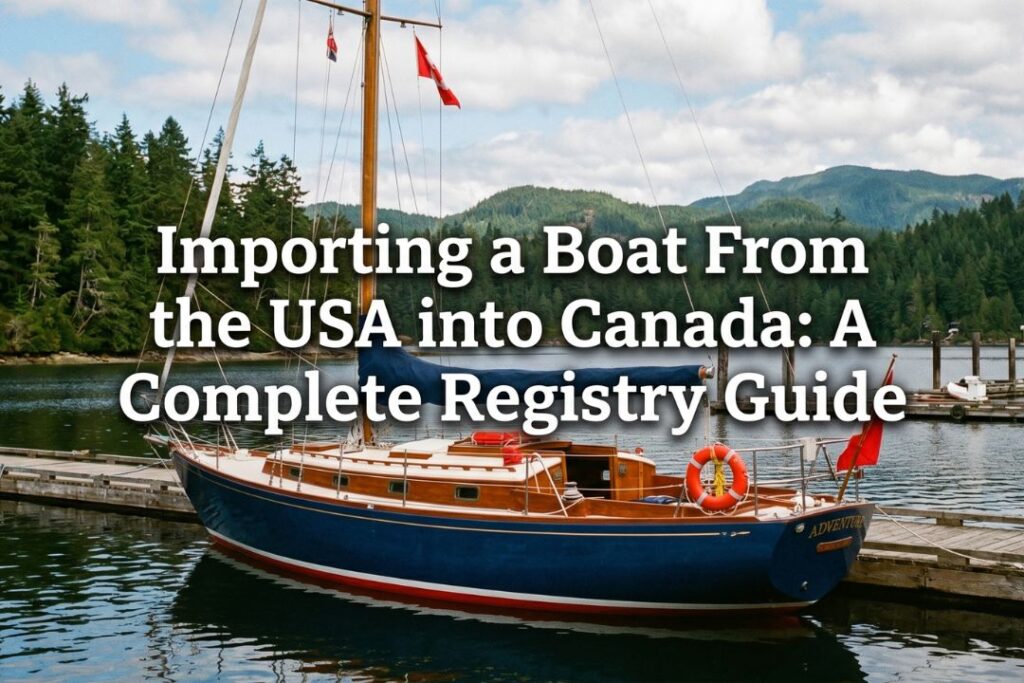
If you are importing a boat from the USA into Canada, you must complete customs requirements, provide proof of ownership, pay applicable taxes and duties, and then decide whether your boat requires a Canadian licence or registration.
At Canadian Vessel Registry, our online service simplifies access to the forms and applications needed to help eligible owners complete Canadian registration processes after their boat enters Canada.
What are the legal steps for importing a boat from the USA into Canada?
Crossing the border with a recently purchased American boat involves more than towing it into Canada. Federal agencies require owners to satisfy customs requirements before they can legally operate or register the boat in Canada.
The process typically involves several stages.
You will generally need to:
- Purchase the boat from an American seller
- Verify ownership information before transport
- Gather all supporting ownership records
- Bring the boat through an approved Canadian border crossing
- Declare the boat to the Canada Border Services Agency (CBSA)
- Pay applicable taxes and duties
- Complete any required Canadian licensing or registration processes
Canadian authorities may ask questions about:
- The boat’s age
- The manufacturer’s information
- The country where the boat was built
- Its intended use
- The purchase price
- Ownership history
You should review official CBSA guidance before bringing your boat into Canada.
What taxes may apply when entering Canada?
Several charges may apply depending on your situation.
These can include:
- Goods and Services Tax (GST)
- Harmonized Sales Tax (HST) in participating provinces
- Provincial sales taxes where applicable
- Customs duties in certain circumstances
The amount you owe will depend on several factors, including where the boat was manufactured and where you reside.
What should you verify before crossing the border?
Before transporting your boat, verify several details.
Check:
- The hull identification number (HIN)
- The seller’s ownership status
- Existing liens or debts
- Existing registrations
- Any discrepancies between ownership documents
Making these checks beforehand can reduce delays at customs.
How do you clear a manufacturing title and proof of ownership at the border?
Documentation is one of the most important aspects of the process. Canadian officials need to verify that the boat legitimately belongs to you and is legally entering the country.
When importing a boat from the USA into Canada, maintaining organized paperwork can make the border crossing significantly smoother.
Documents commonly requested include:
- A signed purchase agreement
- Ownership certificates
- Registration records
- Government-issued identification
- Customs declarations
- Any supporting ownership transfers
What is considered acceptable proof of ownership?
The specific ownership document may vary by state because American boating systems differ throughout the country.
Examples include:
- State titles
- State registrations
- Manufacturer’s statements
- Ownership certificates
The documents should clearly identify:
- The seller
- The buyer
- The boat’s identifying information
- The transaction date
Do you need evidence that there are no outstanding liens?
Yes. If money is still owed on the boat, importing complications may arise.
Buyers should verify that:
- No marine mortgages remain attached
- Existing loans have been satisfied
- There are no ownership disputes
If questions exist regarding ownership status, additional documentation may be necessary.
What if the boat was previously registered in Canada?
Some boats originally came from Canada before being sold into the United States.
In those situations, older Canadian records may still exist. You may eventually need a boat registration transfer if ownership previously changed within Canadian systems and the boat is returning to Canada under a new owner.
Requirements vary according to the boat’s history.
How do you switch your new American boat purchase to the Canadian registry?
After customs clearance, you can determine whether your boat needs licensing, registration, or neither.
Many owners are surprised to learn that Canada has different systems for different categories of boats.
When importing a boat from the USA into Canada, selecting the appropriate path depends on the boat’s characteristics and intended use.
Some boats may require registration.
Others may qualify for licensing instead.
What is a Pleasure Craft Licence?
A Pleasure Craft Licence is a unique identification number assigned to certain recreational boats operating in Canada.
It is not identical to formal registration.
Generally, a licence may apply to recreational boats equipped with motors of 10 horsepower (7.5 kW) or more.
The licence number must be displayed on both sides of the bow.
A licence can help authorities:
- Identify a boat during emergencies
- Confirm ownership records
- Assist with search and rescue situations
When is formal registration required?
Transport Canada registration requirements differ from licensing requirements.
Formal registration may be required for:
- Commercial boats
- Certain financed boats
- Boats requiring marine mortgages
- Boats that must display a registered name
Registered boats receive:
- A unique official number
- A registered name
- A designated port of registry
These benefits are distinct from licensing.
Which Canadian ownership option applies to your boat?
The appropriate Canadian system depends on multiple factors.
When importing a boat from the USA into Canada, owners should carefully determine which pathway aligns with their circumstances.
Factors include:
- Boat size
- Engine specifications
- Commercial usage
- Financing arrangements
- Intended activities
What is the Small Vessel Register?
The Small Vessel Register is a formal Transport Canada registration category used for certain commercial boats and qualifying government-owned boats.
It is separate from recreational licensing systems.
This register may apply if your boat:
- Will be used commercially
- Meets eligibility requirements
- Operates within industries requiring formal registration
Owners should review eligibility requirements before applying.
Can recreational owners still choose registration?
In some situations, yes.
Some recreational owners voluntarily register their boats because they prefer:
- A registered name
- An official registration record
- Eligibility for marine financing
However, not every recreational boat owner must register.
What paperwork should you keep after the import process?
Maintaining accurate records is beneficial long after your border crossing.
Store documents in a secure location.
Recommended records include:
- Customs receipts
- Tax payment records
- Ownership documentation
- Canadian registration records
- Previous American ownership documents
These materials may be needed later if:
- You sell the boat
- You refinance the boat
- You transfer ownership
- Government agencies request verification
Why should ownership records remain accessible?
Future transactions often require proof of your ownership history.
Maintaining records can simplify:
- Insurance applications
- Financing requests
- Ownership transfers
It can also reduce delays if questions arise later.
Should you retain purchase agreements indefinitely?
It is generally wise to keep them.
Your bill of sale establishes an important ownership timeline.
Many owners preserve their bill of sale for a Canadian boat alongside all supporting import records for future reference.
How can registration help after your boat enters Canada?
After customs requirements have been satisfied, many owners want a simpler way to access Canadian applications.
When importing a boat from the USA into Canada, our online service provides streamlined access to eligible Canadian licensing and registration forms without requiring lengthy in-person visits.
Our service focuses on simplifying access to official Canadian boating applications while allowing owners to complete required processes from virtually anywhere.
Because every boat has unique circumstances, owners should verify whether licensing, registration, or another process applies to their specific situation. Once your American boat has legally entered Canada and customs obligations have been satisfied, you can move forward with the appropriate Canadian ownership pathway with greater confidence.