
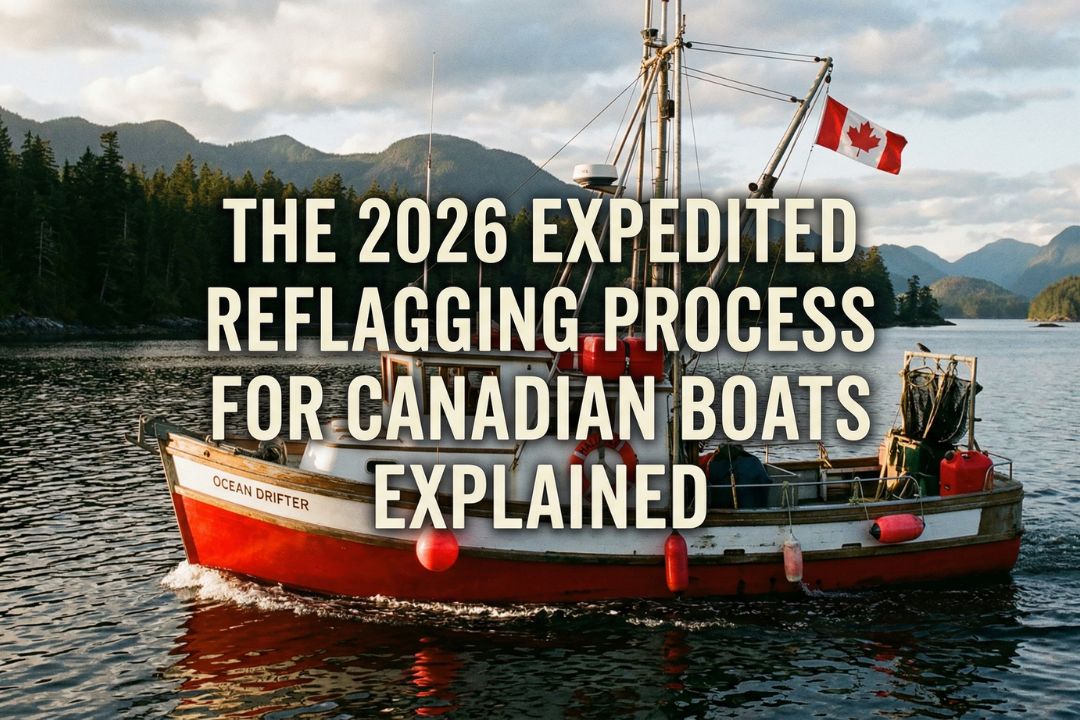
Navigating the complexities of international waters just got significantly easier for Canadian boat owners. As of March 2026, Transport Canada has introduced MSOB 2026-001, a new directive aimed at simplifying the expedited reflagging process in Canada for boats returning to the Canadian boat registration.
Whether you’re bringing a yacht back from a winter charter or transitioning a commercial craft, this update offers a streamlined path to compliance, provided you follow the new rules.
A Longstanding Challenge for Canadian Boat Owners
When a Canadian boat “bareboats out,” it is temporarily leased to a foreign entity and flies another country’s flag. This is a common practice for commercial operations, seasonal charters, and international use. However, the return process has historically been anything but simple.
Previously, re-entering the Canadian registry meant:
- Full security reassessments
- Extensive inspections
- Revalidation of compliance measures
- Significant processing delays
- Increased operational downtime
Even boats that had only been abroad for a short period were subject to these requirements. For owners, that meant lost time, added costs, and unnecessary administrative complexity.
This is the exact problem the expedited reflagging process in Canada is designed to solve.
What the 2026 Bulletin Changes Mean for the Expedited Reflagging Process in Canada
Transport Canada’s updated policy introduces a more efficient pathway for boats returning from a foreign registry under specific conditions.
Instead of restarting the process from scratch, eligible boats can bypass much of the traditional re-certification framework.
This can include:
- Reduced inspection requirements
- Faster processing timelines
- Streamlined administrative review
- Continued recognition of existing compliance measures
This shift reflects a more practical, risk-based approach to marine security—one that acknowledges the operational realities of modern boating.
Eligibility Criteria for the Expedited Pathway
Not every boat will qualify for this updated process. The expedited reflagging process in Canada applies only when specific conditions are met.
To qualify:
- The boat must have been registered under a foreign flag for no more than 12 months
- The owner must notify Transport Canada at least two weeks before leaving the Canadian registry
- The boat must retain at least six months of validity on its existing Vessel Security Plan (VSP)
- The owner must contact a Regional Security Inspector
These requirements are strict but manageable—especially when handled with the right tools and timing.
The Critical Two-Week Notification Window
One of the most important aspects of the new process is the advance notice requirement. Owners must inform Transport Canada at least two weeks before their boat leaves the Canadian registry.
This step is essential because:
- It signals intent to return under the expedited framework
- It allows Transport Canada to pre-assess eligibility
- It preserves the validity of the Vessel Security Plan
- It reduces the need for reinspection upon return
Missing this window can mean reverting to the traditional, more time-consuming process. That is where our service becomes especially valuable.
We make it easier to access and complete the necessary forms quickly, helping ensure that deadlines are met without unnecessary stress.
Maintaining Vessel Security Plan Validity
Another key requirement involves the Vessel Security Plan (VSP). To qualify for the expedited reflagging process in Canada, the boat must still have at least six months of validity remaining on its VSP at the time of return.
This condition ensures:
- Continued compliance with Canadian marine security standards
- Reduced need for reassessment
- Faster reintegration into the Canadian registry
Boat owners who plan ahead can align their timelines to meet this requirement, avoiding delays and complications.
Coordination with Regional Security Inspectors
Participation in the expedited process also requires direct communication with a Regional Security Inspector.
This step involves:
- Confirming eligibility
- Verifying compliance status
- Coordinating return procedures
- Ensuring adherence to Transport Canada guidelines
While this may sound complex, having immediate access to the correct forms simplifies the process significantly. Our platform is designed to remove unnecessary friction, allowing owners to focus on timing and compliance rather than paperwork logistics.
How Our Service Supports Your Reflagging Timeline
At the National Vessel Registry Center Corp., our role is straightforward: we provide easy access to the forms required for Transport Canada processes.
When it comes to the expedited reflagging process in Canada, this makes a measurable difference.
We help by:
- Providing centralized access to relevant forms
- Offering a simplified online interface
- Reducing the time spent navigating government systems
- Supporting accurate and timely submissions
Because the expedited pathway depends heavily on timing, having immediate access to the correct forms can determine whether or not an owner qualifies.
Avoiding Delays When Returning to Canada
Even with the new system in place, delays can still occur if requirements are not met precisely.
Common pitfalls include:
- Missing the two-week notification deadline
- Allowing the VSP to fall below the six-month validity threshold
- Failing to contact a Regional Security Inspector
- Incomplete or incorrect submissions
Each of these issues can disqualify a boat from the expedited reflagging process, forcing a return to the traditional pathway.
Our service helps reduce these risks by making the submission process more accessible and efficient.
Distinguishing Registration from Licencing
While reflagging focuses on registry status, it is important not to confuse this process with other Canadian boating requirements.
For example, a pleasure craft licence applies to recreational boats and serves a different purpose than registry documentation.
A pleasure craft licence:
- Is primarily used for identification
- Is required for certain recreational boats
- Does not confer the same legal status as registry
By contrast, registry involves ownership, nationality, and compliance with Canadian maritime regulations. Keeping these distinctions clear helps ensure that all requirements are met appropriately.
The Role of the Small Vessel Register
Another important system is the small vessel register, which is separate from both full registry and licencing.
The small vessel register is typically used for:
- Commercial boats that do not qualify for full registry
- Boats requiring a unique identifier for operational purposes
- Specific regulatory or business needs
Understanding where your boat fits within these systems is essential when planning a reflagging strategy.
The expedited reflagging process applies specifically to boats within the Canadian registry framework, not to those operating solely under the small vessel register.
Verifying Ownership and Compliance Records
Before initiating any reflagging process, it is often helpful to check boat history. This ensures that all records are accurate and up to date.
Reviewing a boat’s history can help:
- Confirm ownership details
- Identify any outstanding issues
- Verify compliance status
- Support a smoother transition between registries
Accurate records become even more important when working within the tight timelines required by the expedited process.
Strategic Planning for International Operations
Boat owners who frequently operate internationally can benefit significantly from incorporating the expedited reflagging process into their planning.
By aligning timelines and requirements in advance, owners can:
- Minimize downtime between operations
- Reduce administrative workload
- Maintain compliance with Canadian regulations
- Optimize operational efficiency
This level of planning transforms what was once a cumbersome process into a manageable and predictable one.
Leveraging the New Process Effectively
The introduction of this updated pathway represents a meaningful shift in how Transport Canada approaches reflagging. However, its benefits depend entirely on proper execution.
To make the most of the expedited reflagging process, boat owners should:
- Plan reflagging timelines carefully
- Monitor VSP validity well in advance
- Submit notifications within the required timeframe
- Maintain clear communication with inspectors
- Use streamlined systems to access and submit forms
Each of these steps contributes to a smoother, faster return to the Canadian registry.
Supporting Compliance Through Simplicity
The regulatory environment for Canadian boats is detailed and highly structured. While that ensures safety and accountability, it can also create challenges for owners managing international operations.
Our service is designed to simplify one critical aspect of that system: access to the forms required to complete your registration, reflagging, and related processes.
By focusing on ease of use and accessibility, we help ensure that:
- Deadlines are easier to meet
- Requirements are clearer to follow
- Processes move forward without unnecessary delays
Use Your Boat How You Want
The 2026 update to the expedited reflagging process in Canada provides a practical solution to a longstanding issue. For qualifying boats, it removes much of the friction associated with returning to the Canadian registry after operating abroad.
With the right preparation and access to the proper tools, boat owners can take full advantage of this streamlined approach.
At the National Vessel Registry Center Corp., we make it easier to navigate these processes by providing direct access to the forms you need when you need them.