
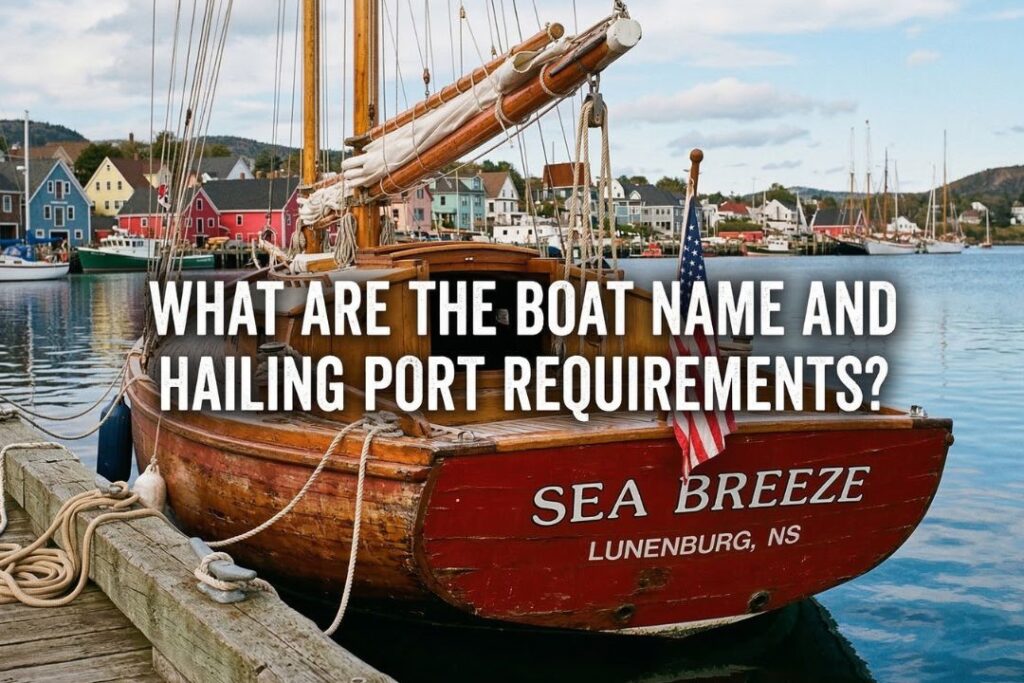
In Canada, the boat name and hailing port requirements refer to the markings that must appear on your boat once it is entered in the national registry system. In Canadian maritime terminology, the “hailing port” is commonly called the port of registry.
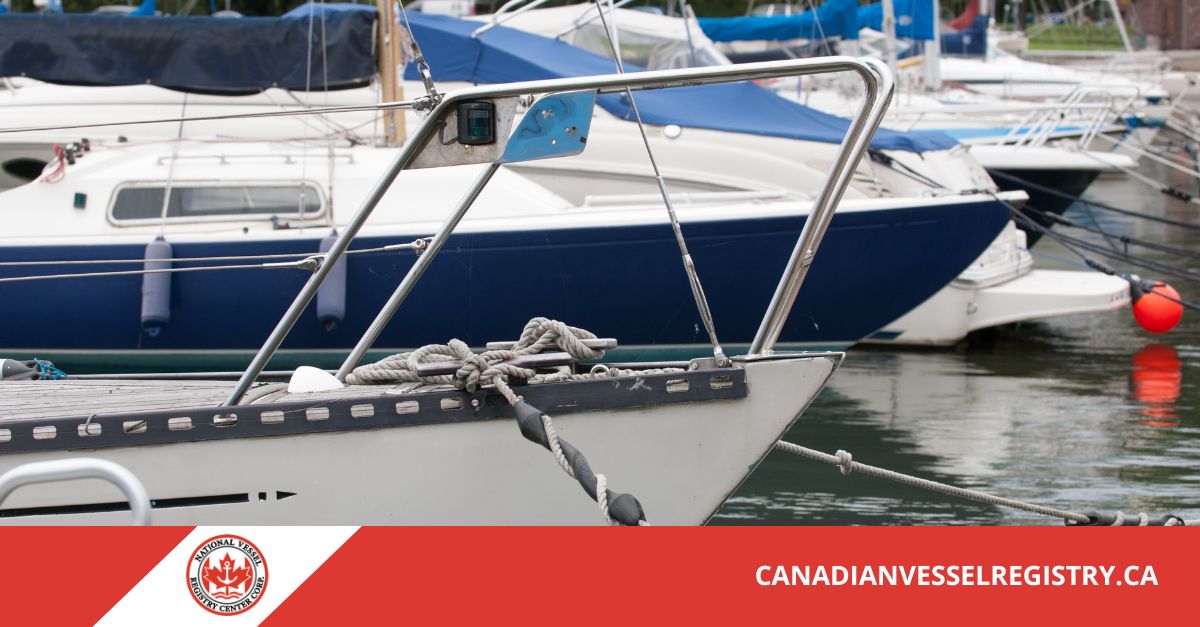
These markings identify your boat and help authorities confirm that it is properly recorded under Canadian maritime laws. If your boat is registered in the Canadian Register of Vessels, the name must appear on the bow and stern, while the port of registry appears on the stern.
These identifiers must meet size, visibility, and placement standards so that your boat can be clearly recognized by enforcement officials and other boaters.
Through our platform, you can submit the forms necessary for registration, updates, and other registry actions so your boat’s identifying markings correspond with its official record.
Marking Rules for Boats in the Canadian Register of Vessels
For boats that appear in the Canadian Register of Vessels, the display rules are very specific. The boat name and hailing port markings must match the name and port listed in the official registry record.
Common marking standards include:
- The boat’s name must be displayed on each side of the bow.
- The same name must also appear on the stern.
- The port of registry must appear on the stern.
- The lettering must be clear, visible, and permanent.
These standards are established through Canadian maritime law and registry practice.
Our service provides the forms that allow you to apply for registration or submit updates when your boat’s identifying details change.
Letter Size and Character Standards
Letter size is part of the official identification requirements.
Typical specifications include:
- Letters must be at least 10 cm high.
- Characters must be in the Latin alphabet.
- Arabic or Roman numerals may be used where appropriate.
- The lettering must contrast clearly with the hull color.
These standards ensure that marine officials can identify boats during inspections or while operating nearby.
Interior Identification for Registered Boats
Registered boats must also display internal identification markings.
These interior markings normally include:
- The official number (O.N.)
- Net registered tonnage (N.R.T.)
These characters must be permanently affixed to a structural part of the boat’s interior, such as:
- A bulkhead
- A frame
- Another permanent structural surface
The characters must typically be at least 4 cm high and remain permanently visible.
Where the Boat Name and Port of Registry Must Appear
Correct placement is essential for compliance. The boat name and hailing port must be displayed where they can be seen from common viewing angles.
Placement guidelines include:
- The boat name appears on both sides of the bow.
- The same name must appear on the stern.
- The port of registry appears on the stern beneath or near the boat name.
This arrangement allows the boat to be identified from different directions:
- From the front as the bow approaches
- From the sides when passing
- From behind when leaving a harbor or marina
Keeping these markings visible helps marine authorities verify your boat’s identity during inspections.
Visibility and Color Requirements
Markings must remain readable in normal operating conditions. The boat name and hailing port must be displayed using colors that contrast clearly with the hull.
Examples of acceptable color combinations include:
- White lettering on dark hulls
- Black lettering on light-colored hulls
- Dark blue letters on pale surfaces
- Yellow or light gray letters on darker backgrounds
Visibility can also be improved through:
- Reflective paint
- High-quality marine vinyl decals
- Raised metal lettering
Boaters should avoid colors that fade quickly or blend with the hull surface.
Maintaining Markings Over Time
Markings must remain legible throughout the life of the registration. If your boat name and hailing port become faded, chipped, or damaged, they may need to be replaced to remain compliant.
Routine upkeep may involve:
- Repainting letters
- Replacing decals
- Cleaning surfaces to remove buildup
Environmental exposure can affect the visibility of markings, especially in regions with intense sunlight or saltwater conditions.
Permanent Marking Standards
The markings must be attached in a way that makes them permanent. Authorities expect that removal would damage or scar the surface where they are placed.
Common acceptable methods include:
- Marine paint
- Marine vinyl decals
- Metal lettering permanently fastened to the hull
Examples of markings that may not qualify include:
- Temporary stickers
- Mailbox-style adhesive letters
- Labels that peel off easily
Permanent identification helps maintain the integrity of the registry system.
Choosing a Boat Name
When registering a boat, the name must meet certain criteria before it can appear in the official registry.
The name selection process generally includes:
- Checking that the name is not already in use
- Avoiding names that are confusingly similar
- Ensuring the name complies with registry rules
Transport Canada also evaluates phonetic similarities. Two names that sound alike over radio communication may be considered duplicates.
Examples of possible conflicts could include:
- Scenic and Sea-Nic
- Horizon and Hori-Zone
Our portal provides access to registry forms that allow you to submit your proposed name for approval.
Using a Vessel Name Search
Before applying, many owners perform a name search.
This helps confirm that:
- The name is unique
- The name does not conflict with an existing entry
- The name can be approved by registry authorities
Submitting your request through the proper forms helps ensure that the name entered into the system matches the markings placed on your boat.
Boats That Use a Pleasure Craft Licence Instead
Some boats operate under a pleasure craft licence instead of being listed in the Canadian Register of Vessels.
These boats follow different display rules.
For licensed boats:
- A licence number must appear on both sides of the bow
- The characters must usually be at least 7.5 cm high
- The number must contrast clearly with the hull
Unlike registered boats, licensed boats do not display a port of registry. Because of this distinction, the boat name and hailing port rules described earlier apply specifically to registered boats rather than boats operating under a pleasure craft licence.
Requirements Related to Small Boat Registration
Certain owners choose to place their boats in the Small Vessel Register, sometimes referred to in everyday conversation as small boat registration.
For these registered boats:
- The name must appear on the bow and stern
- The port of registry must appear on the stern
- Letter size must follow federal standards
- Permanent markings must be used
These boats must also comply with Canadian maritime laws that regulate identification markings.
Our service provides the forms that allow owners to submit their registration request online through the official system.
Updating Markings After a Boat Registration Transfer
When ownership changes, the registration record may be updated through a boat registration transfer.
If the new owner changes the name or port of registry, the hull markings must also be updated to reflect the new registry information.
Updates may include:
- Removing the previous boat name
- Adding the new approved name
- Changing the port of registry
- Updating interior identification numbers if required
These changes must correspond with the official registry record so that the physical markings and government database match.
How Our Portal Helps With Canadian Boat Registration Services
Managing registry actions can involve several steps, particularly when applying for registration or updating identifying information. Our portal simplifies this process by providing direct access to the forms required for Canadian boat registration services.
Through our platform, boat owners can:
- Submit registration forms
- Apply for registry updates
- Request name changes
- Process ownership updates
Our system allows you to complete these actions online, making it easier to align your boat’s official record with the markings displayed on the hull.
What to Remember About Your Boat Name and Hailing Port Markings
The boat name and hailing port rules in Canada exist to ensure that every registered boat can be easily identified on the water.
The primary guidelines include:
- The boat name must appear on both sides of the bow.
- The same name must also appear on the stern.
- The port of registry must appear on the stern.
- Letters must meet minimum size requirements.
- Markings must contrast clearly with the hull.
- Permanent materials must be used.
These markings correspond directly to the official entry in the Canadian Register of Vessels, which is why keeping the registry record accurate is essential.
Our online portal provides access to the forms used for these registry services so boat owners can submit applications and updates efficiently through the Canadian system.