
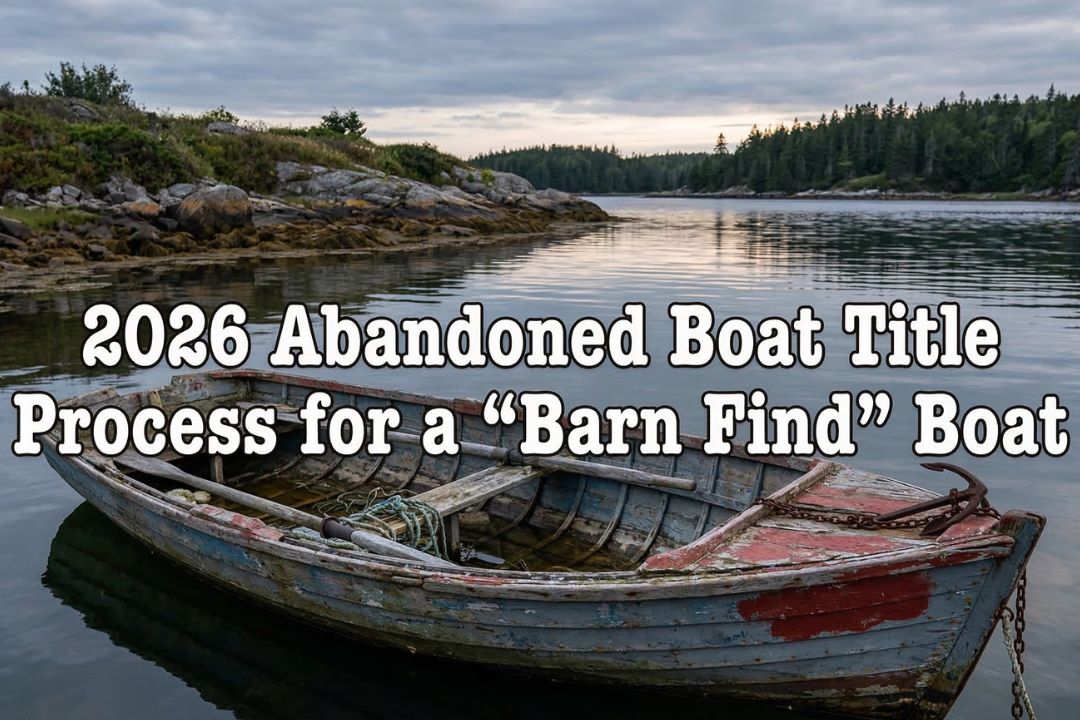
Discovering an old boat hidden away in a barn or storage shed can feel like winning the lottery. However, restoring and using one of these forgotten boats is rarely as simple as cleaning it up and launching it. In many cases, the path forward involves resolving an abandoned boat title situation before the boat can be operated legally.
The paperwork is often missing, and proving legal ownership can be complicated.
When documentation has been lost over time, Canadian maritime laws still require proof that the person claiming the boat has the legal right to do so.
Through our online platform at the National Vessel Registry Center Corp., we provide convenient access to the forms required for Transport Canada processes, including applications related to boat registration, pleasure craft licencing, and related filings.
A restored “barn find” boat can absolutely return to the water, but the steps toward compliance can be a bit tough to navigate. We’re here to help.
When a Boat Is Found Without Paperwork
The Barn Find Scenario
Many boat restorations begin the same way. Someone exploring a family property, rural estate, or storage building uncovers an old boat covered in dust. It may be a vintage Canadian classic from the 1950s or 1960s, such as a Grew runabout or a Peterborough wooden boat.
The boat might still have its original paint and metal fittings, but the documentation is often gone. The original owner may have passed away decades earlier, and any heirs may not know anything about the boat’s paperwork.
Situations like this create the first legal obstacle: establishing ownership.
Without written proof of ownership, the legal chain connecting the boat to its new caretaker is incomplete. Even when everyone involved believes the boat was abandoned or forgotten, official records may still associate it with a previous owner.
This is where resolving an abandoned boat title becomes necessary before the boat can return to regular use.
Legal Requirements for Motorized Boats in Canada
In Canada, a motorized boat with an engine of 10 horsepower (7.5 kW) or greater must hold a valid pleasure craft licence. This requirement ensures that Transport Canada can identify the owner if the boat is involved in an accident, emergency, or enforcement situation.
The licence number must appear clearly on both sides of the bow. Authorities use these numbers to connect the boat to its registered owner in federal records.
However, obtaining a pleasure craft licence typically requires documentation demonstrating that ownership has been transferred legally. The most common document used for this purpose is a bill of sale.
When a boat has been sitting unused for decades, that bill of sale may no longer exist. The seller might be impossible to locate, or there may never have been a formal sale at all.
Statutory Declarations as a Legal Ownership Tool
What a Declaration Under Oath Is
When standard ownership documents are unavailable, Canadian law allows individuals to provide sworn statements explaining how they acquired the boat. This statement is known as a statutory declaration.
A statutory declaration is a legal document signed under oath in front of an authorized official, such as a commissioner of oaths or notary. By signing it, the individual confirms that the information provided is true.
For people restoring older boats, this document can serve as a bridge between an undocumented past and a legally recognized present.
Information Typically Included
A declaration used in boat ownership situations usually includes detailed identifying information about the boat. Providing accurate details helps Transport Canada review the situation and determine whether the claim appears legitimate.
The information generally includes:
- The boat’s make and model if known
- The approximate year of manufacture
- The hull identification number (HIN) if visible
- The boat’s length and type
- A description of how the boat was acquired
- An explanation of why a bill of sale is unavailable
These details help establish a factual record that can support an abandoned boat title claim when traditional documents cannot be produced.
Demonstrating Diligence When Searching for the Previous Owner
The Effort Requirement
Before authorities will accept a statutory declaration, they often expect the claimant to demonstrate that they attempted to locate the previous owner. This effort is commonly referred to as a “diligent search.”
A diligent search helps ensure that the boat was not stolen or mistakenly claimed.
The goal is to show that the person seeking ownership took reasonable steps to locate anyone who might still have legal rights to the boat.
Common Search Methods
In 2026, a diligent search may involve multiple steps, including both official and community-based methods. Providing evidence that these steps were taken can strengthen an abandoned boat title claim.
Examples of these efforts may include:
- Checking available records to see if the boat appears in official databases
- Attempting to identify a previous owner using the HIN
- Reviewing archived records or older paperwork found with the boat
- Posting notices in boating forums or local community groups
- Asking nearby marinas or boatyards if they recognize the boat
Many people restoring older boats also take the step to check boat history using online resources and historical registries.
The Receiver of Wreck and Abandoned Boats
Reporting a Found Boat
Sometimes a boat is not discovered in a barn or shed but instead found drifting or stranded in public waters. In those cases, Canadian law includes a separate reporting process involving the Receiver of Wreck.
The Receiver of Wreck is a government authority responsible for managing reports of maritime property that has been found in navigable waters.
Reporting found property helps ensure that owners have the opportunity to reclaim their boats before someone else claims them.
These procedures form part of Canada’s broader maritime framework, which can be reviewed in official Canadian maritime laws.
Salvage Awards and Ownership Claims
If a boat is reported and no owner steps forward within the legally defined period, the finder may become eligible for a salvage award.
In some situations, the salvage award can involve financial compensation. In other cases, it may include the transfer of ownership of the boat itself.
When no owner is identified, the outcome may eventually support an abandoned boat title claim by the finder.
The timeline and process depend on the specific circumstances, including where the boat was found and whether an owner attempts to reclaim it.
Registering or Licencing a Restored Boat
Pleasure Craft Licencing
Resolving an abandoned boat title is only one stage of bringing a forgotten boat back into compliance.
Once ownership questions have been resolved, the next step is ensuring the boat has the correct authorization to operate on Canadian waters.
For most recreational motorboats, this involves applying for a pleasure craft licence through Transport Canada.
A licence connects the boat to its owner in federal records and must appear visibly on the bow.
Through our portal, boat owners can access the required forms online and submit applications efficiently without navigating multiple government systems.
When Registration Is Required
Some larger commercial boats must be entered in the Small Vessel Register instead of obtaining a pleasure craft licence. These boats typically operate for commercial purposes or require formal registration for financing or ownership reasons.
It is important to note that this register is a separate system from pleasure craft licencing. Each serves different types of boats and legal purposes.
Boat owners restoring older boats should confirm which system applies before submitting their application.=
Licence Renewal Rules Beginning in 2026
Updated Renewal Cycle
A significant regulatory update affecting recreational boats took effect in January 2026. Under current Transport Canada rules, pleasure craft licences must now be renewed every five years.
Previously, many licences remained valid indefinitely unless ownership changed. The new renewal cycle keeps federal records more accurate and ensures that authorities can identify boat owners quickly when needed.
For owners of restored boats, this means keeping licence records current after the initial application is approved.
Old Numbers Cannot Simply Be Reused
People restoring barn find boats often notice faded licence numbers painted on the bow. These numbers may have been valid decades ago, but that does not mean they can automatically be reused.
Before using the boat on Canadian waters, the ownership record must match the person currently operating it.
That means applying for either a transfer or a new licence in the current database system. This step helps ensure the boat’s legal record accurately reflects its current owner.
Online Access to Canadian Boat Registration Forms
The paperwork associated with restoring older boats can feel complicated, especially when ownership documents are incomplete.
Our service provides online access to the forms used in Transport Canada processes so that boat owners can complete applications in one place.
Through our platform, users can access forms related to:
- Pleasure craft licencing applications
- Pleasure craft licence renewal filings
- Ownership transfers
- Canadian boat registration submissions
- Updates to owner information
These digital forms simplify the process of submitting applications for Transport Canada review.
When someone discovers a long-forgotten boat and decides to restore it, having access to the correct forms can help move the process forward efficiently.
Getting An Abandoned Boat Title Legally
Restoring a classic Canadian boat can be an incredibly rewarding experience. Many of these boats were built with craftsmanship that still holds up decades later. After careful repairs, polishing, and mechanical work, they can once again glide across lakes and rivers.
However, the legal process must be addressed along the way. Without resolving ownership questions, even a fully restored boat cannot be used legally.
An abandoned boat title situation may initially seem complicated, but Canadian maritime procedures offer clear paths forward.
By documenting how the boat was acquired, demonstrating diligence in searching for previous owners, and completing the appropriate applications, the boat can eventually return to lawful operation.