
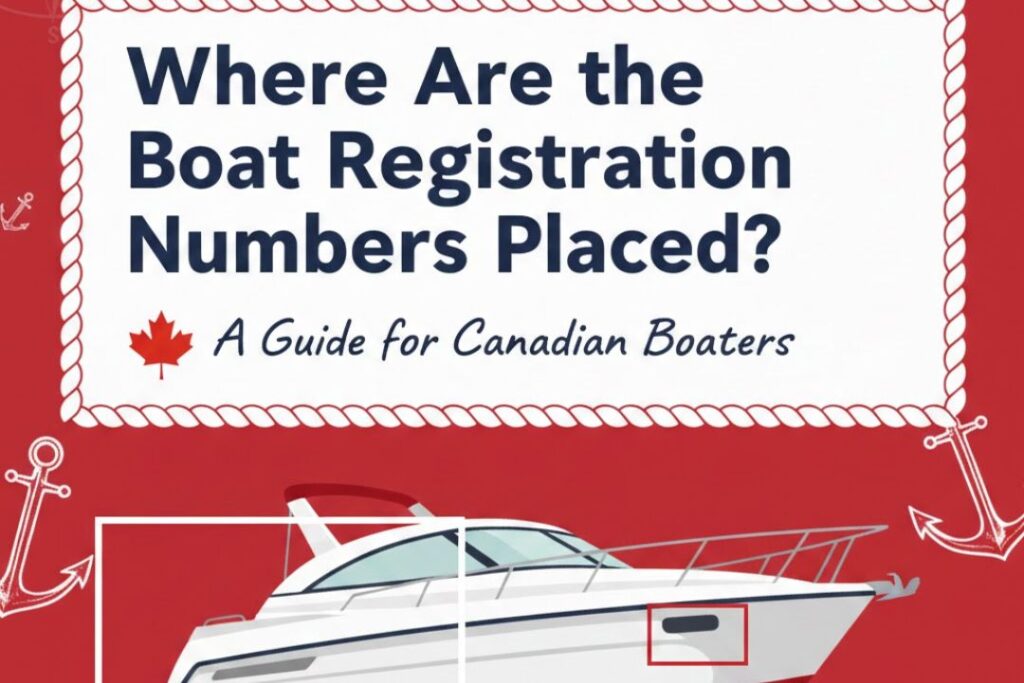
The answer depends on the size of the boat and the category of registration. For most documented boats, the identification appears on the exterior bow and stern and on a visible interior surface, with dimensions defined by federal standards. The placement of Canadian boat registration numbers ensures that ownership, registry location, and measurement data are permanently marked and easily read by authorities in Canada or abroad.
Canadian boat registration
Larger boats, pleasure craft, and boats in the small vessel category follow slightly different marking rules, and each owner is responsible for applying the correct standards.
Our service provides streamlined access to Canadian documentation forms online so boat owners can secure the materials required to register their boat and record the information that later appears in physical markings. These markings legally connect the boat to its certificate and serve as a visible representation of its documented status on the water.
The following details expand upon the requirements and what owners should know before marking their boat.
What Are Canadian Boat Registration Marking Requirements?
Canadian documentation requires owners to attach identifying markings in a manner that makes them permanent, legible, and resistant to alteration. When a certificate is issued, the marking process is not optional. The certificate only has legal force after the boat is properly marked.
The markings should be affixed to the physical structure, using paint, carving, welding, molding, or adhesive designed to create a permanent bond. The intent is to make sure that if anyone attempts to remove, cover, or replace the information, the structure is not damaged or visibly altered.
The specific placement and layout rules differ based on classification. Below, we detail the three categories most owners fall into.
Large Boat Register Marking Rules
Boats documented under the large register carry identification that reflects their name, location of registry, and measurement data. These markings appear externally and internally, and they must be placed in a way that is easily readable.
Owners display the boat’s name using Latin letters or Arabic or Roman numerals. These letters must meet a minimum height threshold of 10 cm and appear on both sides of the bow and also on the stern.
The port of registry must also appear externally. This is displayed on the stern, using the same letter and numeral standards used for the boat name. The minimum height is 10 cm.
Inside the boat, owners must display the official number and net registered tonnage. These markings use block-style Arabic numerals of at least 4 cm in height.
Before the numbers, two prefixes are required:
• N.R.T. before the net registered tonnage
• O.N. before the official number
These markings should be placed on a visible interior structural surface, not on a removable panel, furniture, or accessory.
Owners who applied under the Assigned Formal Tonnage system follow a simplified requirement. They only display the official number, with the O.N. prefix, because the certificate does not include a net registered tonnage value.
boat registration transfer form
What Makes Large Boat Boat Registration Number Markings Compliant?
- Visibility from a normal viewing distance
• Correct letter height and format
• Required prefixes intact
• Placement on structural areas
• Durable material that resists tampering
• Matching configuration to the documentation certificate
Pleasure Craft Marking Rules
Many recreational owners choose to document their boat rather than rely on a pleasure craft licence. Documented pleasure boats display their name, port of registry, and measurement data in a specific physical arrangement.
Markings use legible Latin letters and Arabic or Roman numerals. Letters must be 10 cm in height. The name and port of registry are placed on the outer hull, generally at the stern and bow.
Inside the boat, owners display the net registered tonnage and official number in Arabic numerals. These are block-style characters measuring at least 4 cm in height.
Prefixes remain required:
• N.R.T. precedes tonnage
• O.N. precedes the official number
These internal markings must be located on a permanent interior section of the hull where they can be inspected.
Boaters who used Assigned Formal Tonnage only display the official number internally. The net tonnage does not appear because it is not part of the certificate.
Keys to Compliant Pleasure Craft Markings
- Exterior name and registry location displayed using required size
• Legible letters contrasting with the hull
• Numbers arranged in block style
• Prefixes intact
• Interior placement where officials can easily view the information
Small Boat Register Marking Rules
Boats recorded in the small vessel register have different marking requirements that focus solely on visibility rather than name or tonnage presentation.
Owners display their official number in block-style characters. Minimum character height is 75 mm, and the color must visibly contrast with the boat’s background surface.
The boat registration numbers are placed on both sides of the bow. If the bow cannot physically accommodate the markings, owners may attach a board to the boat as close to the bow as possible. The board must be permanently affixed, not removable, and positioned so the number is visible from either side.
Characteristics of Compliant Small Boat Markings
- Block-style printed numbers
• Height of 75 mm or larger
• Contrasting color
• Placement near or on the bow
• Permanent physical attachment
How Canadian Boat Registration Numbers Marking Relates to Boat Certificates
The certificate and the markings are inseparable parts of Canadian documentation. Markings confirm the identity of the physical boat, while the certificate confirms the registration.
Without compliant markings, the certificate remains inactive.
Markings and certificates must both display the same information, arranged according to the category under which the boat is registered.
Why Marking Registered Boat Numbers Must Be Permanent
The government requires permanent markings because of safety, enforcement, and traceability. Authorities must be able to identify a boat even if papers are missing or electronic records are temporarily inaccessible.
Permanent markings also help prevent:
• Fraud
• Unauthorized transfers
• Improper use in bareboat charters in Canada
• Confusion during inspection or emergency
Exterior Lettering and Numbering Best Practices
- Keep paint edges clean and crisp
• Use high-contrast colors for maximum visibility
• Maintain consistent letter spacing
• Avoid fonts with extreme serifs or italics
• Measure carefully before marking
Interior Canadian Boat Registration Number Marking Placement Tips
- Use a permanent structural surface, not a panel
• Avoid areas prone to abrasion or corrosion
• Ensure visibility without requiring disassembly
• Seal painted characters to prevent wear
Legal Requirements and Compliance
Canada requires these markings under federal maritime regulations. Marking standards tie to federal safety, enforcement, and registry practices.
Boaters are responsible for compliance, whether they operate a recreational boat, commercial fishing boat, or a registration of a government boat.
How We Help You With Boat Registration
Our service makes registration smoother by providing the online forms needed to secure Canadian documentation. Owners can complete submissions for:
• Large boat registry
• Pleasure craft documentation
• small vessel register filing
• Transfer applications
• Boat Registration Renewals
• Status changes
We do not classify, measure, or verify boats. We give boat owners the tools required to interact with the federal registry and maintain compliance with marking standards.
Whether someone is registering a family cruiser or a commercial workboat, they can manage applications online, rather than relying on mailed forms or in-person filing.
Using Markings When Operating Outside Canada
Boats that leave Canadian waters may be inspected by foreign authorities. Proper markings help avoid delays when entering marinas, shipping channels, or customs checkpoints.
Consistent markings also reduce confusion if the boat is inspected in regions with multiple agencies.
Where Canadian Boat Registration Numbers Must Appear
Most owners display identification on both the exterior and interior surfaces. Core placement rules include:
• External name and registry location on large boats and pleasure craft
• Internal tonnage and official numbers on structural surfaces
• Visible bow numbering on small boats
• Permanent attachment for all categories
Canadian boat registration numbers appear on the boat where authorities can read them from either side or inspect them while on board. Markings must reflect information on the certificate and follow the federal formatting specifications.
Canadian Boat Registration Numbers: The Next Step
Owners who plan to document their boat can apply online using our platform. After receiving the certificate, they apply markings according to their category.
Whether the boat is personal, commercial, chartered, or state-owned, registration numbers must be affixed correctly so the certificate remains valid and the boat remains compliant.